

Sir Horace Curzon Plunkett (24 October 1854, Sherborne, England – 26 March 1932, Surrey, England) was an Anglo-Irish, world-renowned agricultural reformer and a pioneer of the Irish co-operative movement. He later became an active figure in Irish politics. In addition, he was also a formidable chess player in his time.
He was an active member of the Dublin Chess Club and later served as its president from 1904 to 1923. He played an important role in inviting the world’s leading chess players to Dublin. In simultaneous exhibitions, he defeated Johannes Zukertort in 1879 (when Zukertort was playing blindfolded). According to his journal, on 14 January 1881 at Molesworth Hall, he defeated William Steinitz after four hours of play, and in 1919 he drew against Raoul Capablanca (see the game below).
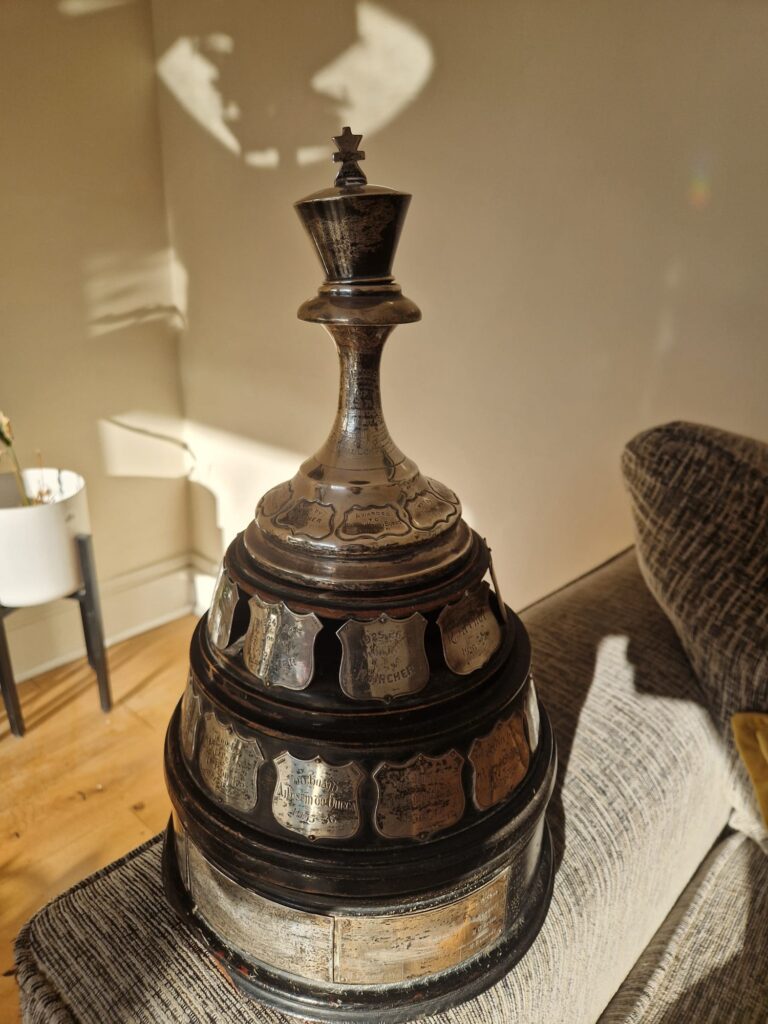
According to the Weekly Irish Times (19 January 1907), the Plunkett Trophy was originally offered for a 35-a-side correspondence team competition between the North (including Dublin) and the South. By May of that year, Sir Horace Plunkett also donated a “Silver King” trophy—manufactured by Fattorini and Son, the renowned Bradford-based jewellers and trophy makers who also produced the original FA Cup—for the Championship of Cork. This competition was restricted to Cork residents who had lived in the county for at least two years.
Reports in the Weekly Irish Times from May to July 1907 indicate that at least 20 players competed for the title. In later years, the tournament became known as the Plunkett Cup (or Plunkett Trophy), in a manner similar to the Dublin city championship known as the Armstrong Cup.
“The Plunkett Trophy was presented to the Cork Chess Association for annual competition for the Championship of Cork. Prior to the establishment of a specific South Munster Championship in the mid-1950s, the winner of the Plunkett Trophy would play a match with the North Munster Champion for the title of Munster champion. Later still (certainly at some time in the 1980s, if not the previous decade), the Plunkett Trophy was awarded to the winner of the Senior Section of the South Munster Chess Association Championships.” (source: IRLChess).
According to retrospective analysis, Sir Horace Plunkett had an estimated Elo rating of around 2000–2100. In memory of his contribution to Irish chess, let this draw against the future World Champion Capablanca (aged 18 in 1919) stand as a testament to his strength.
